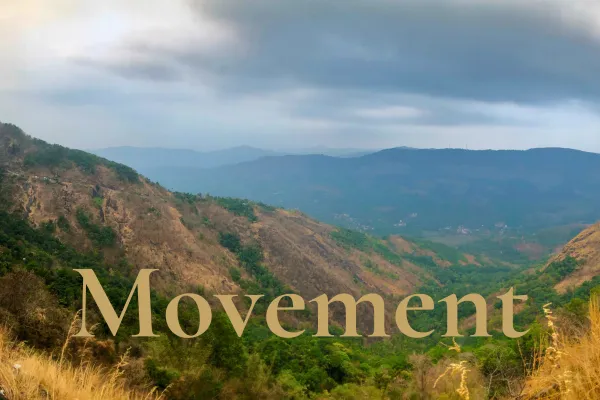
Ridgeline IV - Movement
How To Get Moving Again in the Midst of Founder Fog, Founder Lock, Founder Cognition
"The Terrain Didn’t Change. The Conditions Did."
I was standing on a steep, exposed ridgeline along the Appalachian Trail in Virginia.
Clear skies. Open views. Stable ground.
Then a storm rolled in.
You could see it forming in the distance. Dark clouds pushing against blue sky. The temperature dropped. The wind shifted. Within minutes, rain.
I had just summited and was reclining on a warm, driveway-sized, flat rock. Now I was running to set camp. I zipped the tent just as lightning struck near the path I had just crossed. You could feel it. Smell it.
The terrain hadn’t changed. But the conditions had.
Leadership works the same way.
In the previous essay, we explored Legibility. The ability of a leader or organization to clearly interpret what is happening, what matters, and what to do next. Because organizations cannot act on what they cannot clearly see.
When legibility declines, decisions don’t stop. They slow down, revisit themselves, or they lose placement.
What follows is what that feels like in motion.
Terrain and Conditions
In business, it's easier than most think for leaders to misread what’s happening in moments like this.
Some assume the problem is the conditions.
The market shifted.
Pressure increased.
Something external changed.
And sometimes that’s true.
But more often, conditions don’t create the problem. They reveal it.
The terrain underneath the business—the structure and cultures built over time—determines how much pressure it can withstand.
Strategy.
Team design.
Decision flow.
Capital structure.
These don’t disappear when conditions change, but they are tested by them.
Conditions move quickly. They behave more like weather than structure. And when they shift, movement changes with them. What feels like sudden disruption is often structural weakness being surfaced.
So the issue is rarely just the conditions. And rarely just the terrain. It’s the interaction between the two.
This is why two leaders can stand in the same terrain and face the same conditions, and move very differently. Not because the business changed. But because of how they respond to those conditions does. And beneath all of it sits something even more important.
Whether the structure of the business is strong enough and legible enough to move through it.
Movement Through Terrain
Movement is often misunderstood. It is not choosing between clear options. It is not waiting for certainty.
Movement is how a leader advances within conditions they do not fully control.
The terrain does not pause. It shifts, resists, it constrains. And the conditions move across it.
Leaders do not move in perfect conditions. They move within terrain they are still building and learning to read. When that terrain becomes difficult to interpret, movement begins to change. Not immediately, but gradually.
Founder Fog
Founder fog is the early stage of cognitive degradation under rising complexity. It appears when the terrain becomes harder to read than the structure can support.
Signals blur, conflicting inputs stack, and decisions linger longer than they should. The leader is still moving. But sure-footed placement becomes less certain.
They revisit decisions. Ask the same questions repeatedly in different meetings. And they feel the weight of choices that once felt simple.
Nothing about the leader has diminished. But their ability to place decisions cleanly has begun to erode. This is not failure. It is rising complexity without sufficient structure to interpret it.
Founder Lock
If fog persists, something tighter forms. Founder lock occurs when decision authority compresses upward faster than the organization can distribute it.
Everything routes back to the founder.
Decisions that should live in the team return upstream. Alignment has to be recreated repeatedly. Movement slows, even as activity increases.
From the outside, the founder appears deeply engaged.
From the inside, they are carrying the full cognitive load of the organization. Decision velocity drops. Bandwidth disappears. Again, nothing about the leader has weakened. But the conditions have begun to close in.
One CEO I worked with called this the Pit of Despair.
That captures the weight of it. But not the structure.
You are not isolated. You are exposed.
Exposed to every signal and every decision. Every unresolved tension in the system. There is a familiar pattern here. Napoleon didn’t lose because he stopped moving. He lost when he continued advancing after the conditions had already shifted. This is the principle of the Phric victory.
Momentum remained. Clarity did not.
Founders do the same. They push harder. Drive the team further. Extend themselves beyond what the structure can support. Not because they are reckless. Because they can no longer place decisions with confidence.
So movement becomes careful. And over time, that caution compounds.
The Simplicity Arc
This is not unusual.
Simplicity gives way to complexity. But complexity must eventually give way to a higher form of simplicity.
The progression is not linear. It's an arc. Left alone, systems drift toward disorder. Complexity builds. Only deliberate effort restores order, and whatever controls the system must be capable of matching its complexity.
Consider the evolution of SpaceX’s Raptor engine.
The first generation is exposed and complex.
The second becomes more refined.
The third looks almost unrecognizable.
Fewer visible parts with greater performance. That isn't simplification for aesthetics. It's simplification after complexity has been solved.
Most teams move up the arc. Great teams come back down. But that second half is where clarity returns, efficiency compounds, and movement becomes sustainable again.
Founder Cognition
Eventually, strong organizations restore something essential. Founder cognition.
Founder cognition is not perfect clarity. It is the return of sufficient clarity to move again.
Signals sharpen. Noise fades. Priorities compress.
Decisions begin to place themselves. Not perfectly. But decisively. This does not come from working harder. It comes from restoring Legibility within the system, despite dynamic terrain and conditions.
I’ve seen it happen in real time.
In conversations that begin with pressure and hesitation, something shifts. The signal sharpens. The noise falls away. You can hear it in how they speak, see it in how decisions start to land again.
The pace returns. Not from urgency, from clarity. And when that happens, it doesn’t stay contained.
Cognition propagates.
Leaders think more clearly.
Teams move more confidently.
The system begins to carry its own weight again.
Why This Matters
Most organizations try to solve this with personal optimization.
It’s not always more tools, more systems, more discipline.
Because most founders are not undisciplined. They are oversaturated. The system has become too difficult to read. Until that changes, pressure remains high, and movement continues to degrade.
Clarity restores movement. Because clarity reduces cognitive load, and reduced cognitive load restores decision velocity.
The Question Beneath the Surface
When leadership begins to feel heavy or movement stalls, the instinct is to push harder.
And it makes sense, we reach for control precisely when it feels like it's slipping. Not out of panic. But out of an attempt to stabilize what no longer feels stable.
More effort. More hours. More pressure. These are typical leadership tendencies.
Asking the more useful question is broader, simpler, and more accurate, and can likely save you time, money, and your team.
Has the complexity of my organization, or the conditions surrounding it, outpaced the clarity of its structure?
Not all of that complexity was created by you. But you are responsible for how it is structured, interpreted, and responded to. Because when structure restores legibility, cognition tends to follow. Not always immediately. But reliably.
Closing
Leadership is rarely about pushing harder as you drive for movement, only to achieve a Pyrrhic victory. Big picture, movement isn't the finish line. It's a means to it.
More often, it is about responding to and restoring the conditions that allow movement to stabilize. Some of those conditions are external. Most of what matters is how they are met.
When fog lifts, leaders move differently. Decisions regain speed. Teams regain confidence. Momentum returns.
The leader has not changed. Their ability to place decisions has.
And as that sharpens, the terrain becomes readable again. And when the terrain becomes readable, the ridgeline becomes visible.
The path was always there. It just had to be seen again.