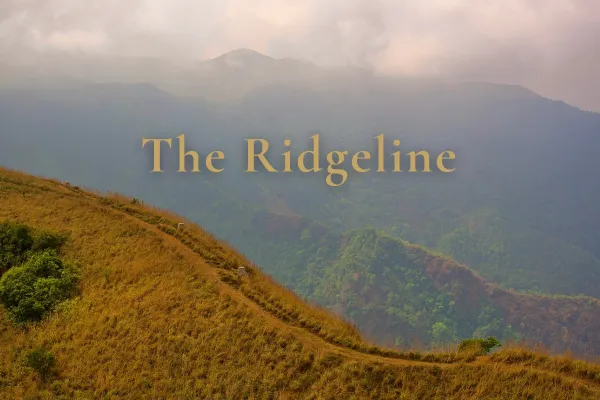
Ridgeline I - The Ridgeline
Some environments clarify you. Others reveal you. Ridgelines do both.
There is a particular psychological effect that occurs above the noise line, where the terrain narrows, distractions fall away, and direction becomes less a preference than a consequence.
Leaders operate in similar conditions more often than is visible from the outside. Decision environments rarely announce themselves. They accumulate quietly through complexity, scale, personnel, capital pressure, and time compression until the margin for imprecision gradually disappears.
At elevation, hesitation is expensive. Clarity becomes structural.
Over time, I have come to believe that many challenges inside organizations are not failures of intelligence. They are failures of orientation.
What the Ridgeline Is
A ridgeline is the narrow path that runs along the highest ground of a mountain range. On either side, the terrain falls away quickly. Movement requires balance, awareness, and disciplined pacing. A step too far in either direction changes the landscape immediately. Leadership at scale operates the same way.
The ridgeline is the narrow space between two common leadership errors: losing clarity or losing attentiveness.
Clarity concerns the system.
Awareness concerns the leader.
Clarity determines whether the terrain is readable.
Awareness determines whether the leader is paying attention to the present and future terrain.
Clarity makes the path visible.
Awareness keeps the leader attentive while walking it.
Lose clarity, and the organization operates in confusion.
Lose awareness, and leaders drift into complacency.
The ridgeline requires both.
Most leaders assume the difficulty of leadership comes from complexity. In reality, the main challenge of leadership is maintaining orientation amid complexity.
Philosophers have long observed that wisdom rarely lives at the extremes. Aristotle called this the Golden Mean, the idea that virtue lies between two extremes, the disciplined middle ground between excess and deficiency. Leadership at scale often resembles this narrow terrain.
The ridgeline is not reckless speed.
But it is not hesitation either.
As organizations grow, decisions narrow. Options that once felt available begin to disappear. Tradeoffs sharpen. Consequences become heavier. The terrain changes.
Early in a company’s life, mistakes are recoverable. The organization is small enough to absorb them. Decisions can be reversed quickly as momentum often compensates for inefficiency. But as the enterprise grows, the margin for error narrows. More people depend on the firm's direction. Capital is committed to the long term. Strategic decisions shape outcomes for years rather than months.
Leadership begins to feel different.
At some point, it begins to resemble movement along a ridgeline. Early-stage organizations can afford exploration. They test markets, experiment with offerings, and pursue multiple directions at once. But as the enterprise grows, the environment changes. The organization carries more people, more capital, and more consequence. The terrain narrows. What once felt like experimentation begins to feel like navigation.
A Familiar Moment
"Leadership at scale is rarely about choosing between two paths.
It is about learning to move along a narrow one.”
Most leaders recognize the moment when this shift occurs, even if they struggle to explain it. Progress begins to feel heavier than it once did. Calendars fill more quickly. Decisions seem to revisit themselves. Meetings multiply while clarity becomes harder to find.
Externally, the organization may still appear successful. Revenue may be growing. The team may be expanding. The market may still be responding. But internally, something feels different.
Effort increases while coherence declines.
Organizations under pressure often respond by accelerating. They add initiatives, expand teams, launch new projects, or pursue additional markets in the hope that motion will produce clarity. But motion does not always produce clarity. Often it obscures it. What appears externally as growth can begin to feel internally like noise.
Researchers studying high-stakes decision environments—from military command to emergency response—have observed a similar pattern: when the environment becomes difficult to read, decision quality declines even among highly capable leaders.
More motion does not produce clarity.
But clarity almost always produces better motion.
Finding the Ridgeline
When organizations lose orientation, the instinct is usually to push forward harder.
But forward motion rarely restores clarity. Orientation does. Finding the ridgeline requires elevation. Leaders must step back far enough to see the terrain again.
This usually reveals a familiar pattern.
Too many priorities competing for attention.
Too many decisions are concentrated at the top of the organization.
Too many initiatives diluting focus.
Clarity restores proportion, and clear organizations move differently.
They pursue fewer things at once. They align decisions more quickly. They protect leadership attention as a scarce resource. Most importantly, they recognize that what an organization chooses not to pursue often protects more value than what it chooses to pursue.
Clarity is not cosmetic. It's economic.
Walking the Ridgeline
Once orientation returns, the work changes again. Walking the ridgeline requires composure.
The goal is not to move as quickly as possible. It is to move deliberately, aware of the terrain and disciplined in pacing. Organizations that learn to operate this way do not eliminate complexity. They design around it.
Operating above the tundra means removing unnecessary noise. They clarify decision authority. They identify constraints quickly and move in alignment. Composed organizations pursue fewer things, but they execute those things with greater force. In time, this posture compounds. Speed returns, not through urgency, but through clarity.
The Question Every Leader Faces
"The higher the stakes become, the narrower the terrain becomes.
Leadership is the discipline of learning to move there."
At some point, every leader must ask a difficult question:
Have we lost the ridgeline?
Because when orientation fades, the symptoms appear everywhere—slower decisions, scattered priorities, and teams waiting for direction that never fully arrives. In those moments, the most valuable step forward is rarely acceleration.
It is elevation.
Closing Charge
Some victories are dramatic. Others are decided long before the contest begins. The leaders who understand the terrain often arrive knowing where the ridgeline lies.
Leadership is often described as the act of driving action. In reality, it is something quieter and more demanding. It is the discipline of maintaining orientation while others are pulled toward motion.
There is an old teaching about two builders. One built on rock, the other on sand. When the storm arrived, the terrain beneath their decisions revealed the difference. Organizations often discover the strength of their foundations in the same way.
The ridgeline is not about caution. It's about awareness. As the stakes rise, orientation shapes outcomes.
Organizations that endure do not simply move faster. They learn where to stand before they move at all.
The Ridgeline is not static terrain. The environment itself shifts as organizations grow. The next essay, Ridgeline II - Terrain, explores how leadership terrain changes and why decision environments rarely stay still.
*Part of the Ridgeline Essay Series exploring leadership decision environments.